Start With the Restaurant Loop
ONE PIECE: Grand Gourmet puts you in charge of a floating restaurant, where better meals and happier customers fund your next expansion. Learning how cooking, decorating, and exploration support one another makes the opening hours easier to manage. Your immediate goal is to turn a small dining operation into a business that can support its growing crew.
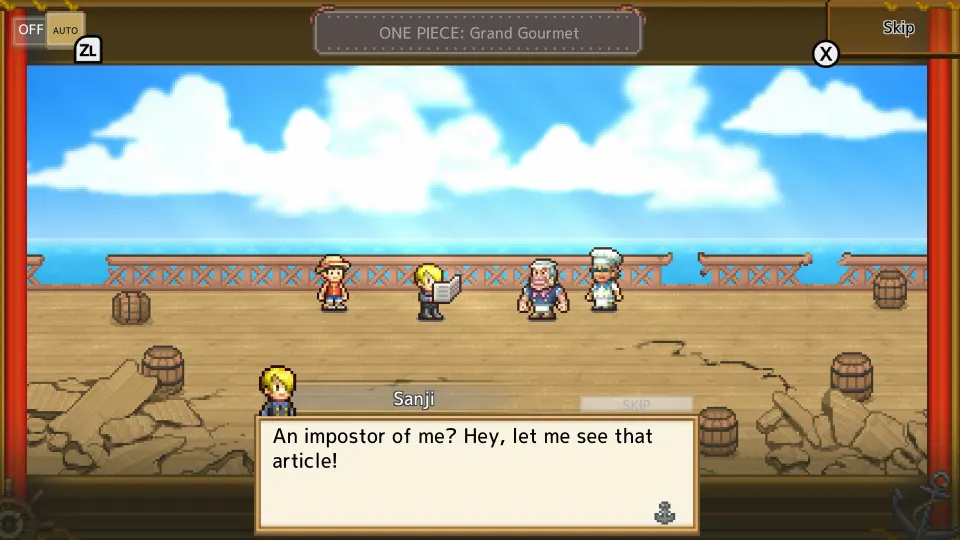
The adventure begins after a storm separates Sanji and Luffy from their companions. Impostors are damaging the Baratie's reputation, so the pair takes charge of another restaurant ship to win customers back through cooking. That setup gives your journey two connected objectives: develop the restaurant and challenge the fakes as you travel.
You start with a kitchen, limited seating, and simple food. Sandwiches introduce cooking while the damaged ship needs attention. Learn how meals generate income before adding more facilities.
Follow this basic cycle:
- Serve customers: Use Sanji's cooking to bring money into the restaurant.
- Improve the ship: Add seating, furnishings, and attractions as your operation grows.
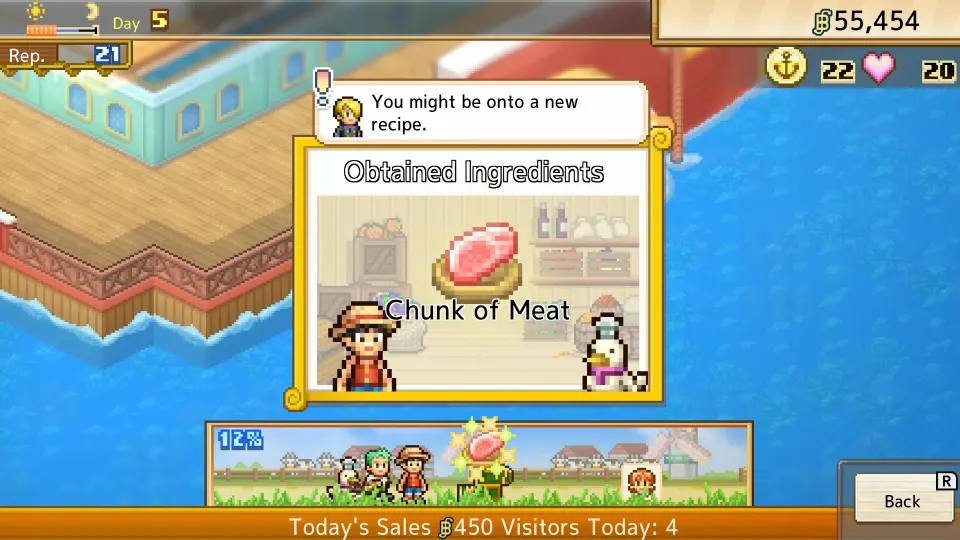
- Explore destinations: Send available crew members out for ingredients, items, and new visitors.
- Develop relationships: Use suitable food and gifts to turn customers into fans.
- Prepare for progress: Learn recipes and strengthen the crew before tackling further challenges.
Build for Comfort and Useful Space
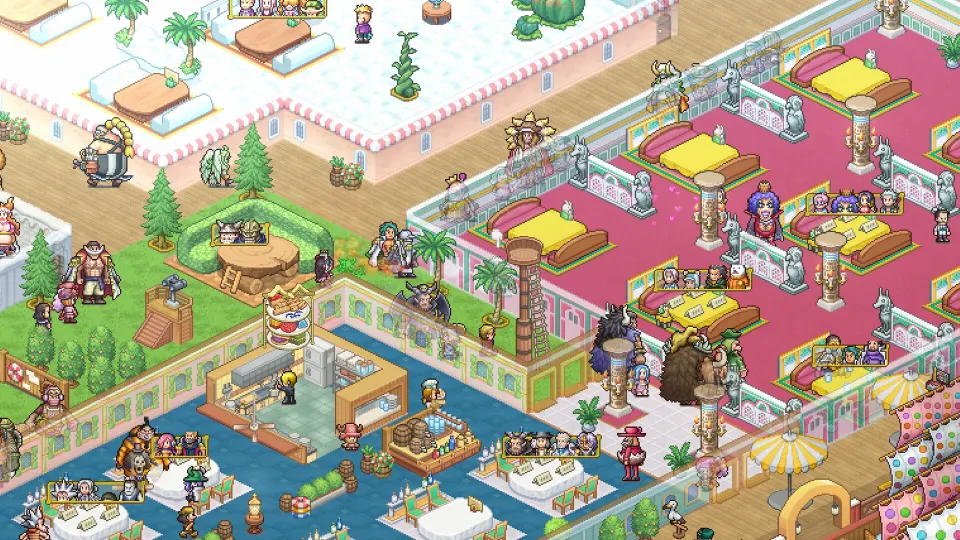
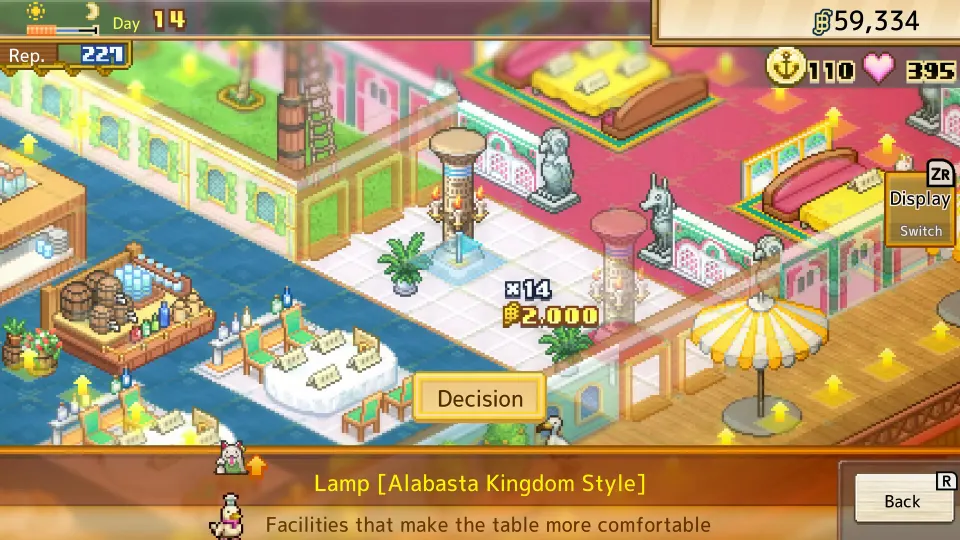
Comfort affects customer happiness and food spending, making furnishings part of your earning strategy. A restaurant that looks attractive to you does not automatically receive a better mechanical result. The game rewards the comfort provided by placed objects, which can encourage crowded arrangements.
More decorations can improve income, but rearranging a cramped deck becomes awkward. Keep the layout manageable, especially while the ship is small and you are still adding facilities.
| Addition | What it contributes | Planning advice |
|---|---|---|
| Tables | Seating for restaurant customers | Include dining space as you build out the ship |
| Lamps, benches, and greenery | Comfort that supports customer happiness and spending | Compare their benefit with the space they occupy |
| Regional furnishings | Decorations themed around different story arcs | Use them to establish a visual theme |
| Creature attractions | Income opportunities and small comfort increases | Treat them as supporting additions |
| Ship expansion | More space for restaurant development | Consider expansion when rearranging becomes difficult |
New regions introduce different furnishings, including flooring, lighting, and landscaping. Thriller Bark brings horror-themed pieces and a place for visiting zombies. These sets let you reflect the current destination, although matching a theme is chiefly a creative choice.
Aquariums, animal-friendly spaces, and meeting spots for creatures such as sea kings add variety. Once established, their ongoing role is relatively simple: they support the restaurant through income and comfort.
Assemble Profitable Meals and Unlock Recipes
Sanji can build meals containing up to four items. Balanced combinations raise the selling price, and pairing food endorsed by the same Straw Hat member can increase it further. Understanding those bonuses matters more to earnings than whether the foods resemble a conventional restaurant order.
The automatic meal tool is a useful starting point because it assembles profitable combinations effectively. Use it to establish a baseline, then experiment manually when you want to understand a pairing or make a themed plate. Manual selection also gives you room to personalize what your restaurant serves.
| Meal feature | Gameplay effect | Useful approach |
|---|---|---|
| Sets of up to four items | Let you combine food into a higher-priced meal | Check combinations instead of considering each dish alone |
| Balanced meals | Increase the meal's selling price | Look at the resulting value when assembling a set |
| Shared Straw Hat endorsement | Can raise the price further | Check whether selected foods share an endorsement |
| Automatic meal selection | Builds effective combinations with little setup | Use it as a starting point for routine service |
| Figures, plates, and utensils | Offer meal presentation options | Customize them when you want a distinctive presentation |
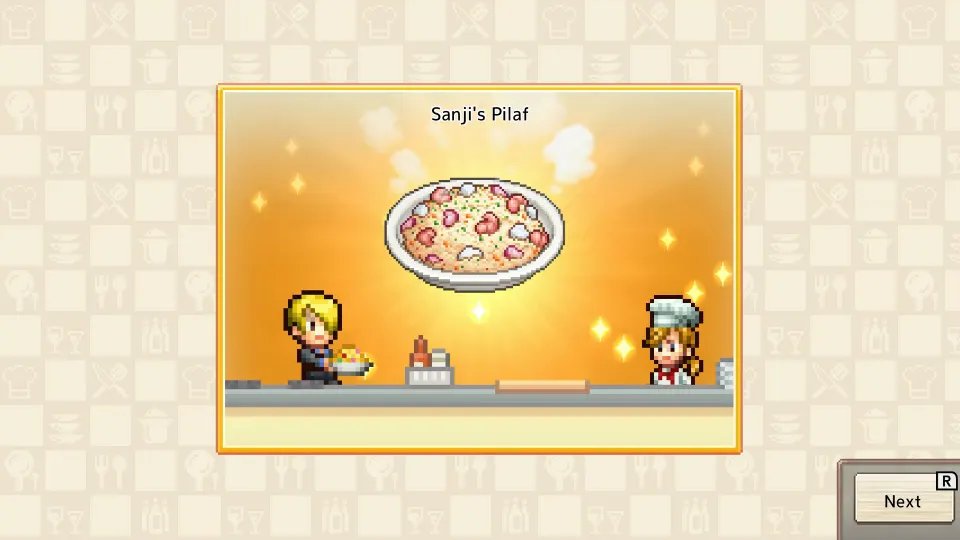
Recipe discovery is more complicated than selecting the highest-priced dish. Sanji draws inspiration from crew members and restaurant visitors, while ingredients obtained through exploration help broaden what the kitchen can produce. New foods also matter for reputation and the cooking contests against the impostors.
Some customers need particular food before becoming fans. Finding the relevant recipe can be frustrating because the connection between a visitor and the food they inspire is not always clear. If progress stalls, broaden your ingredients and visitor pool instead of repeatedly changing an unrelated decoration.
Give Each Straw Hat a Useful Job
The Straw Hats contribute different services to the restaurant. Recruiting them expands your options, and developing the crew helps you meet exploration requirements. Their jobs connect restaurant construction, meal customization, and expedition progress.
| Crew member | Main contribution | Why it matters |
|---|---|---|
| Sanji | Cooks meals | Drives food service and recipe development |
| Franky | Creates furnishings and expands the ship | Supports construction and additional space |
| Usopp | Makes meal decorations and utensils | Expands presentation and customization options |
| Zoro | Trains the Straw Hats | Helps the crew develop further for expeditions and other activities |
| Nami | Provides financial assistance and a daily half-price amenities discount | Makes expensive purchases easier to afford |
Nami's discount is particularly useful when a major amenity purchase is approaching. Consider that daily opportunity before buying an expensive addition at full price. Her financial assistance can also help during difficult stretches, although you should still pay attention to what the business costs to operate.
Zoro's training supports a different kind of growth. Some exploration rewards depend on crew level, while others require a particular member. Developing several characters therefore has practical value beyond making your favorite stronger.
Explore, Win Fans, and Watch Daily Costs
Exploration supplies resources that restaurant decoration alone cannot provide. Luffy and the available crew visit islands, villages, and bases through idle activities. These trips cost berries, affinity points, or coins, depending on the activity, and return rewards that support your business.
| Exploration reward | Restaurant benefit | When to prioritize it |
|---|---|---|
| Ingredients | Support additional cooking possibilities | When you want to develop new dishes |
| New visitors | Expand the characters reaching your restaurant | When you need more potential fans or recipe inspiration |
| Giftable items | Help build fans or improve profitability | When customer relationships need attention |
| Rewards with crew requirements | Give trained or specific characters a purpose | When you can meet the conditions for a desired reward |
Fans are especially useful because they can follow the restaurant into new regions. Before moving on, review any characters you particularly want to keep around. Serving the right food or using an appropriate gift may help, but recipe discovery can prevent every relationship from being completed immediately.
Meanwhile, distinguish purchase costs from daily expenses. Shops, buffets, and hired employees carry recurring overhead. A successful service period does not tell the whole financial story if the next day's operating costs consume those earnings.
A practical checkpoint before expanding is:
- Review the daily costs of facilities and employees already in place.
- Decide whether your next purchase addresses space, comfort, or another current need.
- Consider Nami's daily discount for a costly amenity.
- Keep upcoming exploration costs in mind when spending restaurant income.
FAQ
Is one piece: grand gourmet game play mainly about combat?
The central activity is managing a restaurant ship. You cook, arrange facilities, develop customer relationships, and send the crew exploring. The rivalry with the fake Baratie leads to cooking competitions, so meal development is central to confronting the impostors.
Do I need to choose every meal manually?
No. Automatic meal selection produces effective combinations and can also succeed in cooking competitions. Manual assembly is useful for experimenting with endorsements and making personalized meals, but it is not necessary for every service.
Does attractive decoration automatically improve earnings?
Earnings benefit from the game's comfort statistic, which furnishings and attractions can increase. A visually coordinated room does not automatically outperform a crowded arrangement with more comfort. Balance the statistic with a layout you can comfortably manage.
Why should I train more than one crew member?
Exploration rewards can depend on character level or require a specific Straw Hat. Training and recruiting across the crew gives you access to more opportunities than relying entirely on one favorite.
What should I check before leaving a region?
Review customers you want to turn into fans, available exploration rewards, and unresolved recipe goals. Fans can follow your restaurant onward, so relationship progress deserves attention before departure. Also check whether your current daily expenses leave room for the next stage of development.